Professional legal content services for compliance and business licenses
- What is content marketing for the legal industry?
- Challenges in creating legal content
- Why law firms should invest in content marketing
- The importance of high-quality content for law firms
- Common legal content services
- Step-by-step guide to creating legal content
- GLEADS provides specialized legal content services for businesses
In the past, traditional advertising channels such as television, billboards, and direct mail were the primary methods for law firms to reach their clients. However, in today’s digital era, most clients search for legal information and services online. So, how can law firms effectively attract and engage more potential clients?
The answer lies in developing a comprehensive and strategic content marketing plan. In this article, GLEADS introduces its specialized legal content services, designed specifically for law firms offering legal consultancy, licensing, and related professional services. Let’s explore how this approach can elevate your firm’s digital presence!

What is content marketing for the legal industry?
Content marketing in the legal sector involves creating valuable content, such as blog posts, email newsletters, or social media updates, focused on legal topics that matter to your target audience.
Unlike traditional advertising, which often centers on direct sales, content marketing emphasizes delivering useful information. This approach not only educates potential clients but also strengthens brand recognition and builds credibility for your law firm.
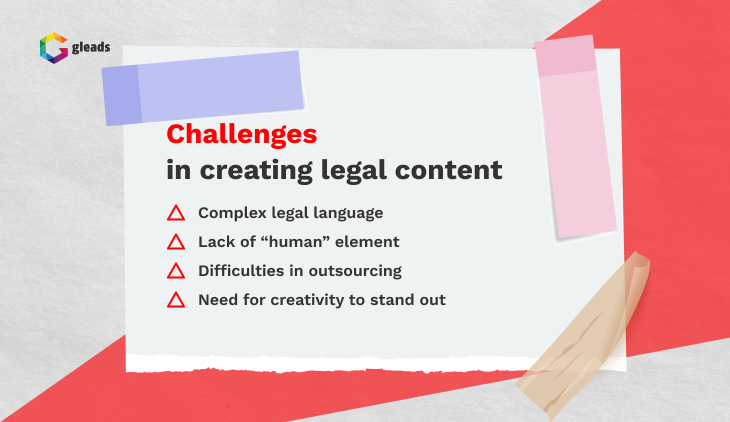
Challenges in creating legal content
Producing high-quality content for the legal industry is no small feat, even for experienced lawyers. Here are some common challenges law firms often face:
Complex legal language
Legal content is usually highly specialized and filled with technical terminology. However, the target audience often lacks a legal background. Striking the right balance between accuracy and readability is a major challenge, requiring strong writing skills and the ability to communicate complex ideas clearly.
Lack of “human” element
Legal content can often feel dry and impersonal, making it harder to engage readers. Successful content typically incorporates human elements, such as personal stories or unique perspectives, making the material more relatable and easier to absorb.
Difficulties in outsourcing
Finding copywriters with deep legal knowledge is not easy. External writers often lack the necessary expertise, while in-house lawyers may not be accustomed to writing in an engaging, client-focused style.
Need for creativity to stand out
The legal sector is highly competitive, so content must be distinctive to capture attention. This requires creativity, a deep understanding of the target audience, and the ability to execute an effective content marketing strategy.
Why law firms should invest in content marketing
Research from the Content Marketing Institute shows that businesses implementing content marketing strategies achieve conversion rates approximately six times higher than those that do not. This is largely because clients prefer to understand and trust a firm before engaging its services, and content marketing meets this need by delivering valuable, targeted information.
Here’s a closer look at the benefits of content marketing for law firms:
Reach the right potential clients
Content marketing allows law firms to target their ideal clients effectively. The most effective approach is to create content based on customer personas.
Each practice area should have a distinct persona, including details such as age, gender, location (e.g., Hanoi, Ho Chi Minh City, Da Nang), education, work experience, and interests. These insights help firms select the most relevant topics and keywords for their content.
For example, in the legal industry, clients can be segmented by areas such as business law, civil law, or real estate law. If targeting small business owners in Hanoi, content could focus on topics like “business license registration procedures,” “required documents for company formation,” or “labor laws for SMEs.”
Increase search visibility
When clients seek legal information, they usually start with Google searches, often clicking on links that appear at the top of search results. This makes content marketing combined with SEO (search engine optimization) essential for law firms.
By producing high-quality content using keywords aligned with client search intent, firms can improve their ranking on Google. Building a trustworthy internal linking structure and encouraging positive client reviews further enhances search visibility. As a result, firms not only attract more potential clients but also establish credibility and professionalism in the legal field.
Convert traffic into leads
Potential clients tend to trust and engage with firms they discover through organic search rather than paid ads. Creating high-quality content provides useful information to readers while showcasing the firm’s expertise and experience, building authority and persuading clients to choose their services.
When developing content, it is important to integrate promotional information naturally without diminishing the content’s value. Clear and compelling CTAs are essential, encouraging readers to take the next step, such as contacting the firm or learning more about its services.

The importance of high-quality content for law firms
In legal marketing, the quality of content always matters more than quantity. Producing transparent, informative content not only helps build trust with clients but also improves a firm’s search ranking on platforms like Google or Bing.
Search engines evaluate content quality based on user intent and data relevance. To stand out from competitors, especially other law firms, a firm’s content should be:
- Accurate: Link to reliable sources when referencing statistics or legal regulations. This reinforces credibility and ensures the integrity of the firm.
- Specific: Avoid vague content. Instead of simply addressing “traffic accident complaints,” provide detailed guidance, such as “how to file a traffic accident complaint in Ho Chi Minh City.”
- Readable: Carefully edit content, check for spelling and grammar errors, and present information clearly with subheadings and short paragraphs.
Common legal content services
To attract visitors and convert them into clients, law firms need to leverage a variety of content types. Here are some popular formats that can enhance a legal marketing strategy:
Blog content
Blogs are ideal for sharing expertise and providing valuable information on legal topics. Easily created and optimized for search engines, blogs help firms stay connected with potential clients through in-depth articles. To maximize effectiveness, firms should post regularly, use clear and accessible language, and incorporate images or videos for added engagement.
Video content
As users increasingly prefer easily digestible content, videos have become a powerful tool for conveying legal messages. Videos can showcase services, answer questions, or provide real-life examples, making it easier for clients to absorb information. Short, engaging videos with high-quality visuals are most effective in capturing viewer attention.
Infographic content
Infographics offer a highly visual way to communicate complex legal information clearly and dynamically. They are an excellent choice for making a strong impression and quickly conveying key points.
Social media content
Social media platforms are ideal for maintaining a presence and connecting with potential clients. Sharing blog posts, videos, or infographics allows firms to promote services and build long-term relationships with their target audience. Consistency in posting and using relevant trending hashtags helps increase engagement and visibility.
Webinar content
Webinars provide a valuable opportunity to share in-depth legal insights or updates on changes in the law. This interactive format allows direct engagement with potential clients, helping to establish credibility and strong connections.
Podcast content
Podcasts are increasingly popular due to their flexibility. They allow firms to share legal knowledge via audio, enabling clients to listen anytime, anywhere. Expert analyses, stories, and advice can effectively capture the attention of those seeking legal solutions.
Case study content
Case studies are essential for demonstrating a firm’s capabilities. By detailing real-life cases and analyzing solutions, firms can build trust, showcase professionalism, and highlight the expertise of their legal team. To reach a broad audience, avoid excessive technical jargon and present information clearly and concretely.
Step-by-step guide to creating legal content
An effective content strategy is essential for law firms to reach more potential clients. However, there is no one-size-fits-all formula. A firm’s strategy should be personalized based on the challenges of its target audience, as well as the firm’s core services and specialties. Gleads provides a detailed guide on creating effective digital marketing content for law firms through the following steps:
Step 1: Research target audience and topics
Before building a strategy, it is crucial to have a clear understanding of your firm and your target audience, including:
- Analyze the firm’s strengths: Identify the areas in which your firm excels, such as intellectual property law, family law, or corporate law. Doing so helps define your core value proposition and differentiates your firm from competitors, attracting clients who need these legal services.
- Define the target audience: To create engaging and effective content, you must know your audience. What legal issues are they facing? Where do they search for information? For example, the target audience may include individuals seeking advice on wills, small and medium-sized enterprises needing legal support in business management, or organizations looking to understand their rights and legal procedures. Understanding these needs helps create content that directly addresses client concerns.
- Research topics: Based on the defined target audience, identify topics they care about. These may include frequently asked legal questions, step-by-step procedural guides, explanations of complex legal concepts, or shared experiences in handling legal matters. Firms can use keyword research tools such as Google Keyword Planner, Ahrefs, or SEMrush to identify popular legal search terms used by their target audience.
For example, if your firm specializes in traffic accident law, keywords like “traffic accident compensation” or “traffic accident settlement procedure” can help you develop engaging topics that attract attention and potential clients.
Step 2: Create and develop content
Once topics are identified, it is time to create content. This stage requires careful planning, time, and effort. Key points to consider include:
- Search engine optimization (SEO): Use relevant keywords naturally within the content to improve visibility on search engines. Avoid keyword stuffing, which can negatively affect readability and user experience.
- Data-driven and research-based approach: Build content based on real research and data rather than solely on personal experience. Understanding audience needs and search trends ensures your content meets demand effectively.
- Content quality: Ensure content is accurate, clear, and engaging. Avoid unnecessary legal jargon and illustrate points with concrete examples to enhance comprehension.
- Professional team: Legal content should be created by qualified professionals such as lawyers or legal experts. This ensures accuracy and enhances credibility with clients.
- Variety of content formats: To attract attention and increase engagement, use multiple content formats, including blog posts, videos, infographics, or podcasts. This diversity helps reach a wider audience with different content consumption preferences.
Step 3: Distribute and publish content
To reach the maximum number of potential clients, law firms should focus on effective distribution to the right audience. Key distribution channels include:
- Company website: The website is the most important channel to reach potential clients. Ensure it is professionally designed, user-friendly, and optimized for all devices, especially mobile, to provide a seamless browsing experience.
- Social media: Share content on platforms like Facebook, LinkedIn, and Twitter to reach potential clients directly. Actively engage with users by answering questions and creating opportunities for interaction to build long-term relationships.
- Backlinks: Building backlinks from reputable websites not only improves search rankings but also increases the credibility of your site. This can be achieved through sponsorships, scholarships, promoting local events, or guest posting on legal blogs.
- Email marketing: Send targeted emails to a pre-built list of potential clients, ensuring their privacy is protected. Make the content engaging, valuable, and include clear calls to action.
Step 4: Evaluate performance
After publishing content, it is important to monitor and evaluate the strategy to ensure goals are being met. This process includes:
- Track key performance indicators (KPIs): Focus on metrics that directly impact success, such as new clients, contract value, keyword rankings, leads generated, and website traffic. These metrics provide a clear overview of content performance.
- Analyze data: Assess the collected data to understand the effectiveness of the strategy, identify strengths to leverage, and detect areas for improvement.
- Adjust strategy: Based on the analysis, refine your current strategy to improve results. This may include updating content, optimizing keywords, or adjusting marketing objectives to better align with actual client needs.
GLEADS provides specialized legal content services for businesses
In the digital era, law firms face significant challenges in producing professional and engaging content. Creating in-depth, valuable articles that attract potential clients requires high levels of skill and expertise.
Understanding this, GLEADS, a leading digital marketing agency, offers comprehensive content marketing solutions specifically tailored for law firms. Our experienced team is committed to producing high-quality, SEO-optimized content that elevates your brand and effectively reaches your target audience.
Our content marketing process at GLEADS
Before starting any content marketing project, GLEADS invests time in understanding your business. We analyze your target audience, research the market, and define specific goals your firm wants to achieve. Based on this, we develop a comprehensive content marketing strategy, including:
- Identifying the target audience: Who is your ideal client? Are they individuals, businesses, or organizations? What are their needs, concerns, and pain points? Clearly defining your target audience from the start lays the foundation for creating content that attracts clients and drives conversions.
- Keyword research: We conduct in-depth research to identify the keywords potential clients use when searching for services related to your practice areas. This enables us to plan content that is optimized for search engines (SEO), increasing your firm’s online visibility.
- Content calendar planning: A detailed content calendar is developed, outlining topics, publishing schedules, content formats (articles, videos, infographics, etc.), and distribution channels. This ensures consistency and effectiveness in your content marketing campaigns.
- Execution and optimization: Once the strategy is approved, Gleads executes all content marketing activities, including writing, graphic design, and social media management. Throughout this process, we continuously monitor and analyze performance to optimize the strategy and achieve the desired goals.
GLEADS’ commitment to quality legal content services
GLEADS’ ultimate goal is to help your law firm succeed. We provide tangible value through:
- Building brand credibility: High-quality content marketing enhances your firm’s professional image and reliability. Well-crafted content positions your firm as a legal authority and establishes trust with potential clients.
- Increasing client engagement: Engaging and informative content attracts potential clients to your website and encourages them to explore your services. This is key to improving conversion rates and driving revenue.
- Personalized services: GLEADS recognizes that every law firm has unique goals and needs. We design tailored content marketing solutions to match your specific objectives.
- Transparent performance reporting: We provide detailed reports on the performance of all content marketing activities, allowing you to track progress, evaluate results, and adjust strategies promptly for maximum efficiency.
In the digital age, an effective content marketing strategy is essential for law firms to enhance their market position and reach clients efficiently. A comprehensive strategy not only attracts potential clients but also strengthens brand credibility in the eyes of your audience.
At GLEADS, we pride ourselves on partnering with law firms to build a tailored content marketing strategy. Our professional solutions help you attract a larger pool of potential clients while reinforcing a trusted, authoritative brand image in the legal sector.
Contact GLEADS today to explore the most effective legal content services for your business!
- What is content marketing for the legal industry?
- Challenges in creating legal content
- Why law firms should invest in content marketing
- The importance of high-quality content for law firms
- Common legal content services
- Step-by-step guide to creating legal content
- GLEADS provides specialized legal content services for businesses
Related Articles

The global international education market is becoming increasingly competitive, marked by the rapid rise in the number of schools and growing expectations from parents. According to ISC Research, by 2024, there were more than 14,000 international schools worldwide, serving 6.9 million students and generating USD 60.9 billion in annual tuition revenue. Notably, Vietnam has witnessed […]

As Vietnam enters 2025, the government continues to roll out policies promoting digital transformation — creating favorable conditions for businesses to unlock new market opportunities. This year marks a pivotal moment for the tourism industry, setting the stage for Vietnam to achieve its vision of becoming a leading economic sector by 2030. Amid this digital […]

The rapid rise of e-commerce in recent years has driven the beauty and fragrance industry to expand aggressively into online channels. While this shift opens up tremendous growth opportunities, it also intensifies competition. In this landscape, many brands face the pressing question: how can they sustainably increase online revenue without relying solely on paid advertising […]

Across Vietnam — from lush green rice fields to time-honored ancient villages — lie stories of history, tradition, and cultural pride passed down through generations. These values form an invaluable foundation for tourism, helping Vietnam emerge as a distinctive destination on the global travel map. According to the Director General of the Vietnam National Administration […]

According to a recent HSBC survey, Vietnamese parents are willing to allocate nearly 50% of their household spending toward their children’s education. At the same time, the number of international schools in Vietnam has increased by 5% over the past two years, placing the country among the top five globally alongside Japan. This rapid growth […]


